tbnpy documentation
TBNpy is a Python toolkit for tensor-based Bayesian network (TBN). TBN tensorises the quantification and inferences of Bayesian networks (BNs) and thereby addresses BNs’ scalability issues when applied to large-scale systems (i.e. high-dimensional system events).
This is the documentation of tbnpy 0.3.1.
What’s new
In 0.3.1:
Joint fields in specs. A
customspec node may own several variables (childs), so a field drawn jointly over many sites is one node, as it is one probability object.Reproducible seeds. A seeded run gives the same samples in every process; before, the sampling order depended on Python’s per-process string hashing.
In 0.3.0:
Readable models. A variable or probability object prints as one line, such as
C(P(C | A, B): normal(loc=A + B, scale=0.6)), andprintshows each variable’s domain. Custom classes get this by inheriting the optional base classtbnpy.Probability.A model check.
tbnpy.check_modelsamples a few rows through a whole model and reports every object that breaks tbnpy’s protocol.Models as data, documented. Specs (
tbnpy.spec,tbnpy.compile) and diagnostics (tbnpy.diagnostics) now have API pages, and the ABCDE example comes as a spec too.
See Changelog for the full list.
Background
Bayesian network is a probabilistic graphical model that can map the causality between variables, for example:
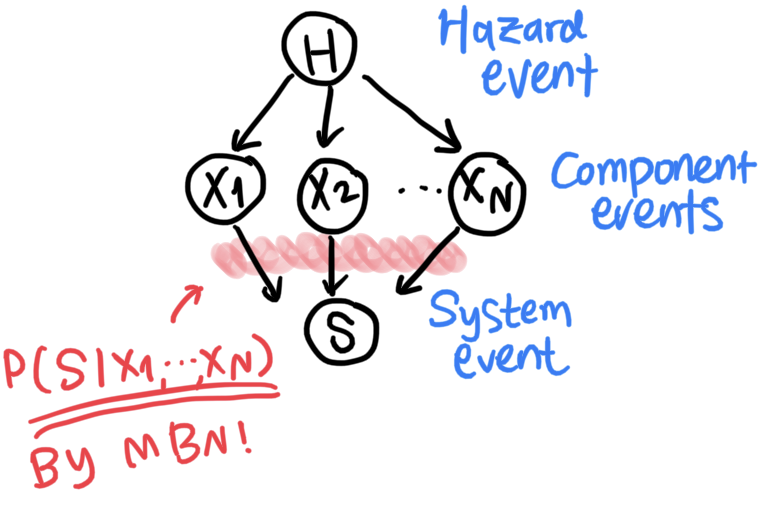
An illustration of a Bayesian network.
For further reading:
For a brief introduction of Bayesian network in the context of system reliability, refer to this blog article.
A formal publication is under preparation.