ABCDE example
This example demonstrates how TBN performs inference on a Bayesian network that combines discrete and continuous variables, using tensorised Monte Carlo sampling and adaptive MCMC.
The example is intentionally minimal, but it exercises the full workflow: model definition, evidence conditioning, scalable inference, and posterior analysis.
Model structure
The Bayesian network consists of six variables:
A: discrete, two states
B: discrete, three states
C: continuous, conditioned on (A, B)
OC: continuous observation of C
D: binary
E: continuous, deterministic function of (C, D)
The BN graph is:
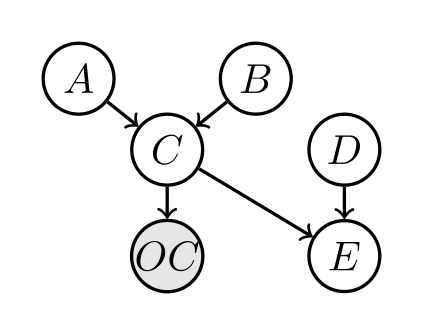
OC is shaded as an observed variable.
Task
Given multiple noisy observations of OC, the task is to infer the posterior distributions of A, B, and C, i.e. \(p(A, B, C \mid OC=\text{evidence})\).
Step 0: Define custom variables and probability distributions
A, B, and D are discrete, tractable (i.e. small state-space) variables, so they use built-in CPT classes.
C, OC, and E are continuous (or non-tabular) variables, requiring custom probability models:
C | A, B: Gaussian distribution with mean and variance depending on the discrete parents (A, B):
 1import torch
 2from torch.distributions import Normal
 3
 4class C:
 5    def __init__(self, childs, parents, sigma=0.6, device="cpu"):
 6        """
 7        C | A,B ~ Normal(A + B, sigma^2)
 8
 9        childs  : [Variable C]
10        parents : [Variable A, Variable B]
11        sigma   : fixed noise std (float)
12        """
13        self.childs = childs
14        self.parents = parents
15        self.device = device
16
17        self.sigma = float(sigma)
18
19        # parent variables
20        self.A = parents[0]
21        self.B = parents[1]
22
23        # value lookup tables
24        self.A_values = torch.tensor(
25            self.A.values, dtype=torch.float32, device=device
26        )
27        self.B_values = torch.tensor(
28            self.B.values, dtype=torch.float32, device=device
29        )
30
31    # ------------------------------------------------------------------
32    def sample(self, Cs_pars):
33        """
34        Cs_pars : (N, 2)
35            Cs_pars[:,0] = A index
36            Cs_pars[:,1] = B index
37
38        Returns
39        -------
40        Cs   : (N,) sampled C values
41        logp : (N,) log p(C | A,B)
42        """
43        Cs_pars = Cs_pars.to(self.device).long()
44
45        A_idx = Cs_pars[:, 0]
46        B_idx = Cs_pars[:, 1]
47
48        mean = self.A_values[A_idx] + self.B_values[B_idx]
49        std = torch.full_like(mean, self.sigma)
50
51        dist = Normal(mean, std)
52        Cs = dist.sample()
53        logp = dist.log_prob(Cs)
54
55        return Cs, logp
56
57    # ------------------------------------------------------------------
58    def log_prob(self, Cs):
59        """
60        Cs : (N, 3)
61            Cs[:,0] = C value
62            Cs[:,1] = A index
63            Cs[:,2] = B index
64
65        Returns
66        -------
67        log p(C | A,B) : (N,)
68        """
69        Cs = Cs.to(self.device)
70
71        C_val = Cs[:, 0]
72        A_idx = Cs[:, 1].long()
73        B_idx = Cs[:, 2].long()
74
75        mean = self.A_values[A_idx] + self.B_values[B_idx]
76        std = torch.full_like(mean, self.sigma)
77
78        dist = Normal(mean, std)
79        return dist.log_prob(C_val)
OC | C: Noisy observation model with Gaussian noise:
 1import torch
 2from torch.distributions import Normal
 3
 4class OC:
 5    def __init__(self, childs, parents, device='cpu'):
 6        """
 7        childs: [OC variable]
 8        parents: [C variable]
 9        OC = C + Normal(0, 1)
10        """
11        self.childs = childs
12        self.parents = parents
13        self.device = device
14
15        # standard deviation is fixed
16        self.std = torch.tensor(0.5, device=device)
17
18    # --------------------------------------------------------------
19    def sample(self, Cs_pars):
20        """
21        Cs_pars: tensor (N, 1)
22            Cs_pars[:,0] = C value
23
24        Returns:
25            OC samples of shape (N,)
26        """
27        Cs_pars = Cs_pars.to(self.device)
28        C_val = Cs_pars[:, 0]
29
30        dist = Normal(C_val, self.std)
31        Cs = dist.rsample()  # (N,)
32        ps = dist.log_prob(Cs)  # (N,)
33
34        return Cs, ps
35
36    # --------------------------------------------------------------
37    def log_prob(self, Cs):
38        """
39        Cs: tensor (N, 2)
40            Cs[:,0] = observed OC value
41            Cs[:,1] = C value
42
43        Returns:
44            log p(OC | C), tensor shape (N,)
45        """
46        Cs = Cs.to(self.device)
47
48        OC_val  = Cs[:, 0]
49        C_val = Cs[:, 1]
50
51        dist = Normal(C_val, self.std)
52        return dist.log_prob(OC_val)   # (N,)
E | C, D: Deterministic relation defined by a function:
 1import torch
 2
 3class E:
 4    def __init__(self, childs, parents, device='cpu'):
 5        """
 6        childs: list [E] (unused but consistent with your structure)
 7        parents: list [C, D]
 8            C: continuous-valued parent (tensor-like values for samples)
 9            D: binary parent (0 or 1)
10        """
11        self.childs = childs
12        self.parents = parents
13        self.device = device
14
15    # ------------------------------------------------------------------
16    def sample(self, Cs_pars):
17        """
18        Cs_pars: (N, 2)
19            Cs_pars[:,0] = C value   (float)
20            Cs_pars[:,1] = D index   (0 or 1)
21
22        Returns:
23            E samples (N,)
24        """
25        Cs_pars = Cs_pars.to(self.device)
26
27        C_val = Cs_pars[:, 0]
28        D_idx = Cs_pars[:, 1].long()
29
30        # E = C if D==0, else 0
31        Cs = torch.where(D_idx == 0, C_val, torch.zeros_like(C_val))
32
33        # deterministic function, i.e. P(E | C, D) = 1
34        n_sample = Cs_pars.shape[0]
35        ps = torch.log(torch.ones(n_sample,)).to(self.device)
36
37        return Cs, ps
38
39    # ------------------------------------------------------------------
40    def log_prob(self, Es):
41        """
42        Es: shape (N, 3)
43            Es[:,0] = E value
44            Es[:,1] = C value
45            Es[:,2] = D state (0 or 1)
46
47        Returns:
48            log p(E | C, D) of shape (N,)
49        """
50
51        Es = Es.to(self.device)
52
53        E_val = Es[:, 0]
54        C_val = Es[:, 1]
55        D_idx = Es[:, 2].long()
56
57        # Deterministic rule: valid_E = C if D==0 else 0
58        expected_E = torch.where(D_idx == 0, C_val, torch.zeros_like(C_val))
59
60        # Valid if E_val == expected_E
61        is_valid = (E_val == expected_E)
62
63        # log 1 = 0 for valid, log 0 = -inf for invalid
64        logp = torch.where(is_valid, torch.zeros_like(E_val), torch.full_like(E_val, -float("inf")))
65
66        return logp
Important notes
A custom probability model class should include (at minimum) the following methods:
__init__defines core properties such aschilds,parents, anddevice(cpuorgpu). Additional properties may be added as needed.samplegenerates samples of child variables conditioned on given samples of the parent nodes.Inputs:
selfandCs_pars, whereCs_parsis a tensor of shape(num_samples, num_parents)storing realisations of the parent variables.Returns: - (recommended) a tensor of child samples of shape
(num_samples, num_childs)- a tensor of log-probabilities of shape(num_samples,)for the generated samples
log_probcomputes the log-probability of given samples.Inputs:
selfandCs, whereCsis a tensor of shape(num_samples, num_childs + num_parents)storing realisations of both child (first) and parent (second) variables.Returns: a tensor of shape
(num_samples,)storing log-probabilities.
All methods should be compatible with both CPU and GPU tensors and should use PyTorch tensor operations for efficiency.
Step 1: defining variables and probability models
The file s1_define_model.py defines:
Variables (discrete vs. continuous)
Conditional probability objects for each node
In particular:
P(A) and P(B) are defined using categorical CPTs
P(C | A, B) follows a Gaussian model
P(OC | C) is a noisy observation model
P(E | C, D) is deterministic
This separation between variables and probability objects allows TBN to mix arbitrary discrete, continuous, and deterministic relations within a single network.
The full model definition is shown below.
 1import os, sys
 2BASE = os.path.dirname(os.path.abspath(__file__))
 3sys.path.append(BASE)
 4
 5repo_root = os.path.abspath(os.path.join(BASE, "../.."))
 6if repo_root not in sys.path:
 7    sys.path.append(repo_root)
 8
 9from tbnpy import cpt, variable
10import numpy as np
11import torch
12
13import c, oc, e
14
15device = ('cuda' if os.environ.get('USE_CUDA', '0') == '1' else 'cpu')
16
17def define_variables():
18    varis = {}
19    varis['A'] = variable.Variable(name='A', values=[-0.3, 0.3])
20    varis['B'] = variable.Variable(name='B', values=[-0.2, 0.0, 0.2])
21    varis['C'] = variable.Variable(name='C', values=(-torch.inf, torch.inf))  # Continuous
22    varis['OC'] = variable.Variable(name='OC', values=(-torch.inf, torch.inf))  # Continuous
23    varis['D'] = variable.Variable(name='D', values=[0, 1])      # Binary
24    varis['E'] = variable.Variable(name='E', values=(-torch.inf, torch.inf))  # Continuous
25
26    return varis
27
28def define_probs(varis, device='cpu'):
29    probs = {}
30
31    #probs['A'] = cpt.Cpt(childs=[varis['A']], C=np.array([[0], [1]]), p=np.array([0.1, 0.9]), device=device)
32    probs['A'] = cpt.Cpt(childs=[varis['A']], C=np.array([[0], [1]]), p=np.array([0.5, 0.5]), device=device)
33    #probs['B'] = cpt.Cpt(childs=[varis['B']], C=np.array([[0], [1], [2]]), p=np.array([0.05, 0.15, 0.80]), device=device)
34    probs['B'] = cpt.Cpt(childs=[varis['B']], C=np.array([[0], [1], [2]]), p=np.array([0.3, 0.4, 0.3]), device=device)
35
36    probs['C'] = c.C(childs=[varis['C']], parents=[varis['A'], varis['B']], device=device)
37    probs['OC'] = oc.OC(childs=[varis['OC']], parents=[varis['C']], device=device)
38
39    probs['D'] = cpt.Cpt(childs=[varis['D']], C=np.array([[0], [1]]), p=np.array([0.4, 0.6]), device=device)
40
41    probs['E'] = e.E(childs=[varis['E']], parents=[varis['C'], varis['D']], device=device)
42
43    return probs
44
45if __name__ == '__main__':
46    varis = define_variables()
47    probs = define_probs(varis, device=device)
48    print("Defined variables and probabilities.")
49
Step 2: evidence and scalable inference
The file s2_run_sample.py performs inference conditioned on evidence
for OC.
Key steps are:
Prior sampling — forward inference
Forward inference (i.e. inference without any evidence) can be performed using
inference.sample_evidencewith an empty evidence dictionary. See the functionsample_prior.Posterior inference — MCMC sampling
Evidence definition. Multiple observations of OC are generated and stored in a tabular format, allowing batched conditioning.
Forward sampling initialisation. Initial MCMC chains are generated using forward sampling from the prior, improving stability and convergence.
Adaptive MCMC. An adaptive Metropolis–Hastings sampler is used to infer the posterior of (A, B, C) given the evidence, i.e. P(A, B, C | OC=oc).
TBN evaluates many Monte Carlo samples simultaneously by reformulating inference computations as tensor operations. This enables efficient scaling across chains, evidence rows, and iterations.
import os, sys
from pathlib import Path
BASE = os.path.dirname(os.path.abspath(__file__))
RESULTS = Path(__file__).parent / "results"
sys.path.append(BASE)

repo_root = os.path.abspath(os.path.join(BASE, "../.."))
if repo_root not in sys.path:
    sys.path.append(repo_root)

import torch
import numpy as np
import pandas as pd
import matplotlib.pyplot as plt

from tbnpy import inference, adaptiveMH
from s1_define_model import define_variables, define_probs

"""
Overall structure:
s2_run_sample.py
├─ define variables & probs   (already done)
├─ define evidence
├─ forward sampling (initialisation)
├─ adaptive MH run
├─ posterior extraction
└─ plotting
"""

def define_evidence(n_evi=10, seed=123):
    """
    Evidence DataFrame: shape (n_evi, n_evidence_vars)

    OC ~ Normal(0, 0.15)
    """
    rng = np.random.default_rng(seed)

    evidence = pd.DataFrame({
        "OC": rng.normal(loc=-0.3, scale=0.05, size=n_evi)
    })

    return evidence

def sample_prior(probs, variables, n_sample=5000):
    """
    Sample prior for all variables using forward sampling.

    Parameters
    ----------
    probs : dict
        BN probability objects
    variables : dict or list
        Variable objects
    n_sample : int
        Number of prior samples

    Returns
    -------
    dict[var_name -> np.ndarray]
        Each array has shape (n_sample,)
    """
    # one dummy evidence row (no conditioning)
    evidence = pd.DataFrame(index=[0])

    # ensure variable list
    if isinstance(variables, dict):
        var_list = list(variables.values())
    else:
        var_list = list(variables)

    query_nodes = [v.name for v in var_list]

    probs_copy = inference.sample_evidence(
        probs=probs,
        query_nodes=query_nodes,
        n_sample=n_sample,
        evidence_df=evidence,
    )

    # container for prior samples
    prior = {}

    for prob in probs_copy.values():
        Cs = prob.Cs  # shape (1, n_sample, dim)
        for j, child_var in enumerate(prob.childs):
            name = child_var.name
            prior[name] = Cs[0, :, j].detach().cpu().numpy()

    return prior

def forward_initialise(probs, latent_vars, evidence, n_chain):
    """
    Use forward sampling to initialise MCMC chains.
    """
    probs_copy = inference.sample_evidence(
        probs=probs,
        query_nodes=[v.name for v in latent_vars],
        n_sample=n_chain,
        evidence_df=evidence,
    )
    return probs_copy

def run_mcmc(probs, varis, evidence, update_blocks, burnin=200, n_chain=5000, n_iter=2000, progress_every=100):
    sampler = adaptiveMH.HybridAdaptiveMH(
        probs=probs,
        variables=list(varis.values()),
        evidence_df=evidence,
        n_chain=n_chain,
        adapt=adaptiveMH.AdaptConfig(
            burnin=burnin,
            gamma=0.6,
            target_accept=0.234,
            alpha=0.5,
        ),
    )

    # --- Initialise from forward samples ---
    probs_copy = forward_initialise(
        probs,
        sampler.latent_vars,
        evidence,
        n_chain,
    )
    sampler.init_state_from_forward_samples(probs_copy)

    # --- Run MCMC ---
    out = sampler.run(
        n_iter=n_iter,
        store_every=10,   # thin
        update_blocks=update_blocks,
        progress_every=progress_every,
    )

    return sampler, out

def extract_posterior(sampler):
    """
    Returns dict[var_name -> 1D np.ndarray]
    (all evidence rows and chains flattened)
    """
    posterior = {}

    for v in sampler.latent_vars:
        x = sampler.state[v.name]  # (n_evi, n_chain)
        posterior[v.name] = x.detach().cpu().numpy().reshape(-1)

    return posterior


import numpy as np
import matplotlib.pyplot as plt

def plot_prior_vs_posterior(prior, posterior, var, bins=60, fname: str = None):
    """
    Plot prior vs posterior for one variable.

    Parameters
    ----------
    prior : dict[str, np.ndarray]
        Prior samples for all variables
    posterior : dict[str, np.ndarray]
        Posterior samples for all variables
    var : Variable
        tbnpy Variable object
    bins : int
        Number of bins for continuous histograms
    fname : str, optional
        File name to save the plot (saved in RESULTS folder). If None, the plot is not saved.
    """
    name = var.name

    if name not in prior:
        raise KeyError(f"Variable '{name}' not found in prior samples.")
    if name not in posterior:
        raise KeyError(f"Variable '{name}' not found in posterior samples.")

    x_prior = prior[name]
    x_post = posterior[name]

    plt.figure(figsize=(5, 4))

    # Discrete variable
    if isinstance(var.values, list):
        K = len(var.values)
        bins_disc = np.arange(K + 1) - 0.5

        plt.hist(
            x_prior,
            bins=bins_disc,
            density=True,
            alpha=0.5,
            label="Prior",
            color="gray",
        )

        plt.hist(
            x_post,
            bins=bins_disc,
            density=True,
            alpha=0.6,
            label="Posterior",
            color="tab:blue",
        )

        plt.xticks(range(K), var.values)
        plt.ylabel("Probability")

    # Continuous variable
    else:
        plt.hist(
            x_prior,
            bins=bins,
            density=True,
            alpha=0.5,
            label="Prior",
            color="gray",
        )

        plt.hist(
            x_post,
            bins=bins,
            density=True,
            alpha=0.6,
            label="Posterior",
            color="tab:blue",
        )

        plt.ylabel("Density")

    plt.xlabel(name)
    plt.legend()
    plt.tight_layout()
    if fname is not None:
        plt.savefig(RESULTS / fname, dpi=300)


if __name__ == "__main__":
    device = "cuda" if os.environ.get("USE_CUDA", "0") == "1" else "cpu"

    varis = define_variables()
    probs = define_probs(varis, device=device)

    # Prior distribution without evidence
    prior = sample_prior(probs, varis, n_sample=10_000)

    # Posterior inference with evidence
    n_evi = 20
    evidence = define_evidence(n_evi=n_evi)

    n_chain = 100
    n_iter = 30_000
    burnin = 200

    query_varis = {v: varis[v] for v in ['A', 'B', 'C', 'OC']} # only infer OC's ancestors
    query_probs = {k: v for k, v in probs.items() if any(c.name in query_varis for c in v.childs)}
    update_blocks = ['A', 'B', 'C']

    sampler, out = run_mcmc(
        query_probs,
        query_varis,
        evidence,
        update_blocks = update_blocks,
        burnin=burnin,
        n_chain=n_chain,
        n_iter=n_iter,
        progress_every = 100
    )

    posterior = extract_posterior(sampler)
    for _, v in query_varis.items():
        if v.name in evidence.columns:
            continue  # skip evidence variables
        plot_prior_vs_posterior(prior, posterior, v, fname=r"plot_" + v.name + f"_{n_evi}_evi_{burnin}_burnin_{n_chain}_chains_{n_iter}_iters" + ".png")

    print("Acceptance rates:")
    for k, v in out["accept_rate"].items():
        print(f"  {k}: {v:.3f}")
Prior vs posterior distributions
The prior and posterior distributions for variables A, B, and C illustrate how evidence propagates through both discrete and continuous parts of the network.
A: posterior probability shifts relative to the prior
B: moderate posterior update through indirect influence
C: posterior density becomes narrower
This demonstrates how noisy observations constrain latent variables.