
Why Our Disaster Models Keep Missing the Communities That Lose the Most
11 Mar 2026Tags: publication structural-systems
Ref: Byun, J.-E., Vatteri, A.P., Lo, D., & D’Ayala, D. (2026). A Bayesian network framework for quantitative analysis of education continuity under earthquake risk: integrating physical and social vulnerabilities. International Journal of Disaster Risk Reduction, 137, 106084.
doi: 10.1016/j.ijdrr.2026.106084
Motivation
When an earthquake hits, some schools collapse. The ones that survive often get repurposed as shelters. Either way, children in vulnerable neighbourhoods lose their classrooms. After the 2023 Türkiye earthquakes, about 40% of surveyed schools were damaged — and the intact ones became shelters and distribution hubs, staying closed for weeks. Similar patterns played out in Haiti 2021, Nepal 2015, and many others.
We know this happens. What we don’t have is a good way to model it quantitatively before the next event — one that accounts for both the structural side and the social side in a single framework.
What we tried
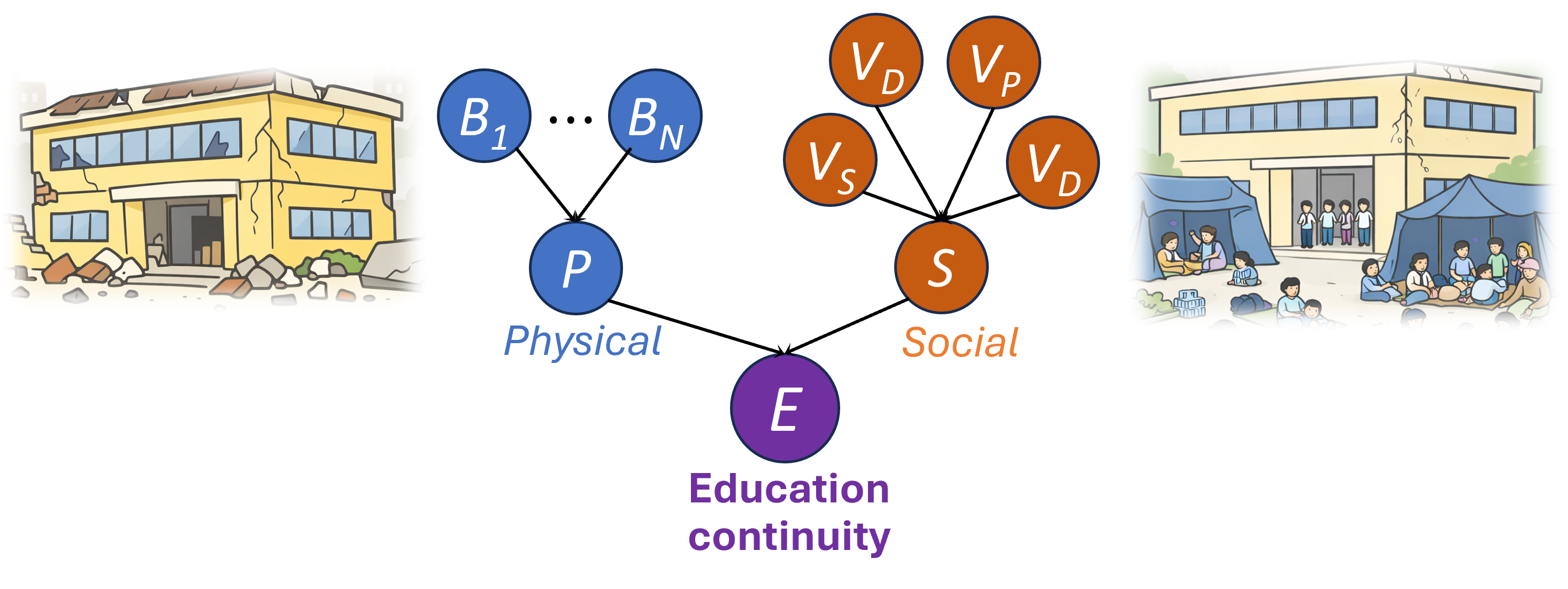
In our new paper in the International Journal of Disaster Risk Reduction, we proposed a Bayesian network (BN) that wires physical and social vulnerability together. On the physical side, each school compound is treated as a system of buildings with seismic fragility profiles from the GLOSI database. On the social side, four indicators — settlement type, housing quality, economic condition, and presence of dependents — feed into a shelter demand model, calibrated through a Delphi survey with 18 local experts in Cagayan de Oro, Philippines.
The BN connects these two modules so that education continuity depends jointly on whether the school is structurally functional and whether the surrounding community needs it as a shelter.
What was interesting
Applying this to seven schools under a design earthquake scenario, social vulnerability — not structural damage — turned out to dominate education disruption risk for most schools. The most influential factor varied by location: housing quality in some neighbourhoods, poverty in others, settlement informality in others.
Perhaps more telling: when we compared the expert-informed model against a naive baseline assuming equal factor contributions, the expert-weighted version produced substantially higher disruption probabilities. The experts recognised compounding effects that additive models miss. Vulnerability factors don’t just sum — they interact.
What we don’t know yet
This is a proof of concept, and the honest answer is that validation remains the hardest part. We need post-earthquake data that simultaneously captures building damage, shelter occupancy, and school reopening timelines — for the same locations, in the same event. That data barely exists, because collecting it requires engineers and social scientists doing coordinated fieldwork together. That kind of genuinely multidisciplinary reconnaissance is rare, and it’s what this line of work most needs.
There are also modelling assumptions worth scrutinising: fixed school–neighbourhood associations, a deterministic hazard scenario, and social indicators that would need recalibration in different country contexts.
Why we think it matters
The core idea is straightforward: Bayesian networks can serve as a shared quantitative language between physical and social vulnerability. The framework is open-source (MBNpy), the fragility data draws on the public GLOSI database, and the Delphi methodology is replicable. We’d welcome scrutiny, alternative applications, and — most of all — collaboration on the validation problem.